
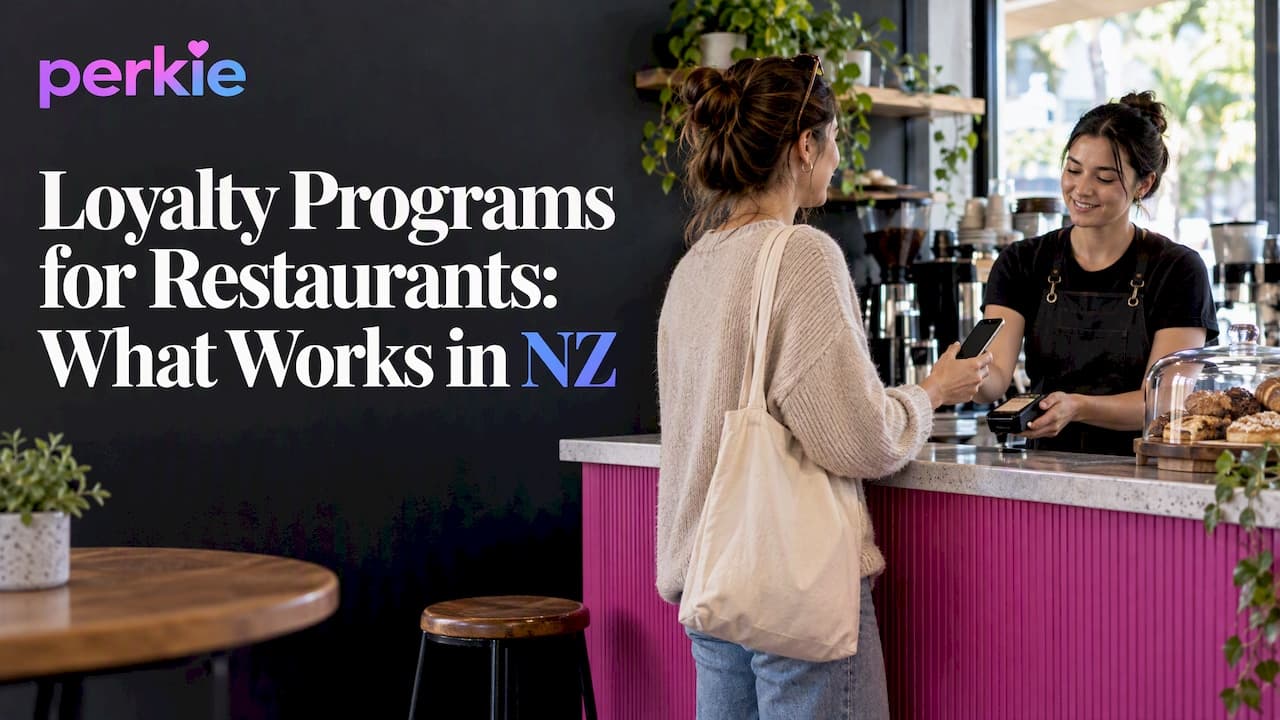
A restaurant loyalty program rewards people for coming back. They join, their visits or spending are recorded, and they redeem points, stamps or perks once they hit a threshold. The best ones are simple to join, clear about the rules and worth the effort for both sides. This guide covers the main types, what Kiwi diners should check before signing up, how owners can choose a model and measure it, and where a free, local option like Perkie fits.
-
A loyalty program rewards repeat customers with credits such as points, stamps, discounts, or perks that can be redeemed later. Common models include points, stamps, tiers, paid memberships, and value-based perks.
-
About 22% of New Zealand consumers belong to a venue-specific on-premise loyalty program, with most members frequently using their benefits, indicating strong demand.
-
Diners should review expiry dates, redemption limits, and data-use policies before joining. Owners should make joining easy and keep the rules straightforward.
-
Perkie offers free membership for both diners and businesses, combining digital loyalty, bookable quiet-time deals, receipt-based rewards, and competitions within a single platform.
-
A loyalty program is a scheme where repeat custom earns credit (points, stamps, discounts or perks) that can be redeemed later. Common models are points, stamps, tiers, paid membership and value-based perks.
-
About 22% of New Zealand consumers belong to a venue-specific on-premise loyalty program, and most members use the benefits often, so the demand is real.
-
Diners should read expiry dates, redemption limits and data-use terms. Owners should keep joining easy and the rules plain.
-
Perkie is free for members and for businesses to list. It combines digital loyalty, bookable quiet-time deals, receipt-based rewards and competitions in one membership.
Table of Contents
What a restaurant loyalty program actually is
Strip away the branding and every program does the same four things: it identifies the customer, records qualifying activity, accumulates a reward and lets the customer redeem it. A restaurant gets a reason for you to choose it again, plus some knowledge about how often you come and what you order. The Shout describes these schemes as structured incentives that reward repeat patronage with points, discounts, free items or special perks, and notes that restaurants use the customer information they gather to send targeted offers.
New Zealand law even has a definition. The Goods and Services Tax Act 1985 treats a loyalty programme as a consumer incentive scheme under which customers can obtain loyalty points redeemable for goods or services. That matters mostly to accountants, but it shows these schemes are a recognised part of how Kiwi retail and hospitality work.
The main types of restaurant loyalty programs
Xero NZ groups programs into four broad types: points-based, tiered, paid-membership and value-based. Points can be earned through purchases, referrals, email sign-ups, social activity or birthdays, and redeemed for free products, discounts or similar rewards. Here is how those play out in a restaurant or café.
| Type | How it works | Best for | Watch out for |
|---|---|---|---|
| Stamps or punch card | Buy a set number of items, get one free. Xero’s example is a free coffee after nine purchases. | Cafés, bakeries, takeaway shops with frequent low-ticket visits | Easy to copy, little data unless it is digital |
| Points per dollar | Earn points for each dollar spent, redeem for vouchers or dishes | Casual and mid-range dining with varied spend | Short expiry windows, minimum redemption thresholds |
| Tiers | Higher spend or more visits unlock better perks | Groups or venues with a loyal regular base | Complexity, and diners who never reach the top tier |
| Paid membership | Customers pay a fee for ongoing perks | Venues with strong demand and a clear value story | A hard sell for new customers |
| Value-based perks | Rewards linked to what the customer cares about, such as community causes or experiences | Independent, community-minded venues | Needs a clear message to stay credible |
Many local programs blend these. Lone Star, for example, awards one reward point per dollar spent and has four levels named Ranger, Deputy, Sheriff and Royal. That is points and tiers working together.
Why diners and restaurants both keep signing up
The appeal for a diner is straightforward: you were going to eat out anyway, so why not get something back? For the restaurant, a returning customer usually costs less to win than a new one, and a reward gives you a reason to pick them over the café next door.
The New Zealand numbers support this. The CGA by NIQ On Premise Pulse+ report, as covered by The Shout, found 22% of New Zealand consumers are enrolled in venue-specific on-premise loyalty programmes, and 78% of those members use their benefits frequently. The same report found loyalty schemes in pubs are more popular with people aged 35 to 54 and 55 and over, while 18 to 34-year-olds are more likely to use schemes in late-night and cocktail bars. In other words, the right design depends on who actually walks through your door.
What diners should check before joining
Not every program is as generous as the sign on the counter suggests. Before you hand over your email or download an app, check four things.
-
Expiry. Consumer NZ looked at several programs and reported BurgerFuel’s $15 voucher for 150 miles had a two-week expiry, which the company said it was reviewing. A reward you cannot use in time is worth nothing.
-
Redemption rules. Terms often limit one redemption per visit, restrict which channels count (in-store, online, delivery) and bar combining offers. Lone Star’s published terms cover all of these, plus expiry dates and how often points can be earned.
-
Your data. Consumer NZ says customer data is in many cases sold or shared with third parties, and that companies should be clear about when and how they use it. The Commerce Commission’s grocery market study made a similar point, noting that complex reward structures and opaque data practices make it hard for people to decide whether to take part. That study looked at supermarkets, but the lesson applies to any scheme: read what you are agreeing to.
-
The real return. Work out what a dollar of spending earns you. Consumer NZ cited a 0.75% return on one supermarket card, which is a useful benchmark for how modest some rewards are. A free dish after ten visits can beat a tiny percentage back, or the reverse, depending on how you eat.
A practical test: if you cannot explain the reward rule in one sentence, the program is probably more complicated than it needs to be.
How restaurant loyalty apps and rewards apps work
Most apps follow the same flow. You sign up with a phone number, email, QR code or membership ID. Your visits or spending are recorded, either by scanning a code at the counter, linking a payment, or uploading a receipt. Rewards build up in your account and are marked as used when you redeem them.

The advantage over paper cards is obvious: nothing to lose or forget. Digital-only schemes also work for the business. Foodstuffs, for instance, launched a currency-based loyalty programme across New World stores in November 2024, replacing its earlier coalition points scheme, which shows even the biggest Kiwi retailers are moving to in-house digital models.
The drawback for diners is app overload. Signing up to a separate app for every café gets old quickly. That is why many people prefer one membership that covers several local places, which is the idea behind a local rewards platform.
Choosing a program as a restaurant owner
The National Restaurant Association says good programs are easy to join without asking for too much information, are accessible online, on mobile and in person, and clearly explain points, tiers, rewards, redemption and expiry. That is a handy checklist, and it is mostly about removing friction.
Match the model to your visit pattern
A coffee cart with daily regulars suits stamps. A restaurant where a table spends $120 once a month suits points per dollar or a perk like a birthday dish. If your problem is empty tables on Tuesday afternoons rather than lack of regulars, a loyalty scheme alone will not fix it. You need a reason to book at a specific quiet time.
Decide what you want to learn
A program that gives you nothing back in information is just a discount. Even a simple record of visit frequency lets you notice who has drifted away and nudge them with a timely offer. Keep the data you collect to what you will actually use, and tell customers plainly how you use it.
Do the sums before launch
Before you promise a free dish, calculate the food cost of that reward, divide by the spend needed to earn it, and check the effective discount is one you can live with. Then put a sensible expiry on rewards and state it up front, so nobody feels tricked later.
Measure with a few numbers
Track the share of transactions from members, how often members visit compared with non-members, redemption rate, and how many quiet-time covers come from offers. Review monthly for the first quarter, then quarterly. If members visit no more often than anyone else, the reward is not strong enough or the rules are too hard.
Last-minute and quiet-time deals: the other half of loyalty
People searching for restaurant rewards also want something else: a table tonight for less. Loyalty points reward past behaviour, while a last-minute or off-peak deal gives a reason to come now. For a restaurant, filling a seat that would otherwise stay empty is often worth more than a discount on a seat that would have been full anyway.
The two work well together. A diner finds your place through a quiet-time offer, enjoys it, and then earns rewards on the next visit. That is the loop local businesses want, and it is the loop Perkie is built around. For more on how Kiwis are stretching their dining budgets, see our piece on how Kiwis are saving money in 2026.
Our perspective: loyalty should be local and free to start
We built Perkie because we saw a gap. Plenty of Kiwis want to support local cafés, restaurants and shops, but nothing rewards them for doing it, and small businesses cannot afford the software that big chains use to keep customers coming back.
Our view is that a loyalty program should not be a cost barrier. That is why Perkie does not charge members or businesses to join or list. The core product, visibility, digital loyalty and rewards, is free. We earn a booking fee only when someone reserves a Perkie Moment, a bookable deal during a quiet time, and we are planning a paid Premium plan for businesses that want advanced analytics, multiple offers and extra promotional tools. A business that never upgrades still gets the free listing.
We also think rewards should follow the money you spend locally. Members can earn for spending at participating businesses through receipt-based rewards, and can enter competitions. We have given away over $5,400 in prizes so far, which is a small number next to a national chain, but it is real money that went to people backing local places.
Finally, we think one membership beats ten apps. Diners should not need a separate download for every venue, and a business should not need a developer to run a loyalty offer. If you want to go deeper on where local marketing is heading, read our take on loyalty, community and smart offers.
— User
How Perkie works for diners and restaurants
For diners, Perkie is a free membership that pulls together local dining, accommodation and retail perks. You can browse deals, book a Moment at a quiet time, earn rewards from receipts and enter competitions. Tourists use it to find places locals actually go to, and locals use it to keep their spending in the neighbourhood.
For restaurants, a free listing puts you in front of members who are looking for somewhere to eat, and lets you offer digital loyalty without printing a card or paying for a platform. If you want more tools later, the Premium plan is on the way.
Start by looking at the deals in your area: Auckland, Hamilton, Dunedin, Whangārei and Nelson all have their own pages. To see how we compare with other ways of finding discounts, our guide to the best deals websites in New Zealand is a good next step, and you can see what is up for grabs on our competitions and winners page. Or head to Perkie and sign up.

A simple way to get started
If you are a diner:
-
Pick one membership that covers several local places rather than downloading a new app for each.
-
Read expiry and redemption terms before you spend.
-
Use quiet-time offers for midweek meals, and save points for bigger occasions.
If you are a restaurant owner:
-
Decide what behaviour you want: more regular visits, higher spend or fuller quiet periods.
-
Pick the simplest reward that encourages it, and write the rules in plain English.
-
List on a free local platform first to test demand before paying for software.
-
Review the numbers after a month and adjust.
FAQ
What is the best loyalty program for a small restaurant?
The best one is the simplest one your customers will actually use. For a small venue, that usually means a digital stamp or points scheme with a clear reward, or a free listing on a local rewards platform that already has members. Start free, see whether regulars respond, and only then consider paying for more tools.
Are restaurant loyalty apps worth it for diners?
They are if the reward is worth more than the effort and you actually eat there regularly. Check the expiry date, redemption limits and what the app does with your data before you join. A single membership covering many local venues is usually less hassle than several single-restaurant apps.
How do restaurants make money from a loyalty program?
Mostly through repeat visits and higher spend from members, not from the program itself. Owners should cost each reward, set a sensible expiry and track how often members return compared with other customers. If members do not visit more often, the reward needs rethinking.
Where can I find last-minute restaurant deals in New Zealand?
Local deal platforms list offers that restaurants release for quiet times. On Perkie, you can book a Moment at a participating business, with a booking fee charged when you reserve. Browse our cheap deals page to see what is available.
Sources
-
The Shout: How to utilise customer loyalty programmes in your on-premise
-
Commerce Commission: Market study into the retail grocery sector, executive summary
-
CXM Today: Foodstuffs launches loyalty programme with Lobyco
-
National Restaurant Association: What makes a good restaurant loyalty program